Brake Pads vs. Rotors: What's the Difference?
QUICK ANSWER: Brake pads are the friction material that clamps onto the rotor when you press the pedal, and rotors are the metal discs that pads squeeze against to create that friction and slow the wheel down. Pads are built to wear out first, usually somewhere between 25,000 and 60,000 miles depending on driving style and conditions, while rotors typically hold up longer before needing resurfacing or replacement. Most pads include a small metal tab that contacts the rotor and produces a high-pitched squeal once the friction material has worn down to roughly a quarter of its original thickness, giving an audible warning before metal starts grinding on metal. Rotors don't come with a built-in warning sound, so rotor problems like warping or uneven wear usually show up as pulsing or vibration through the brake pedal instead. The two parts wear on different schedules but affect each other directly, since pads worn past their friction material will groove the rotor surface, and a warped rotor will chew through a fresh set of pads unevenly.
The service writer sets two worn parts on the counter, side by side: a brake pad with a shallow crescent worn into its friction material, and a rotor with a groove circling its face like a fingerprint. Your invoice sits next to them, and the question that comes up almost every time follows right behind it. Which one of these actually needed replacing? Why does the shop check both instead of just the one that squealed?
For a driver who's never had a wheel off, pads and rotors blur into one vague category called "brakes." They're not the same part. They don't wear out for the same reasons, and they don't wear out on the same schedule. Mixing the two up is the easiest way to either pay for something that didn't need replacing yet, or drive around on something that did.
What a Brake Pad Actually Does
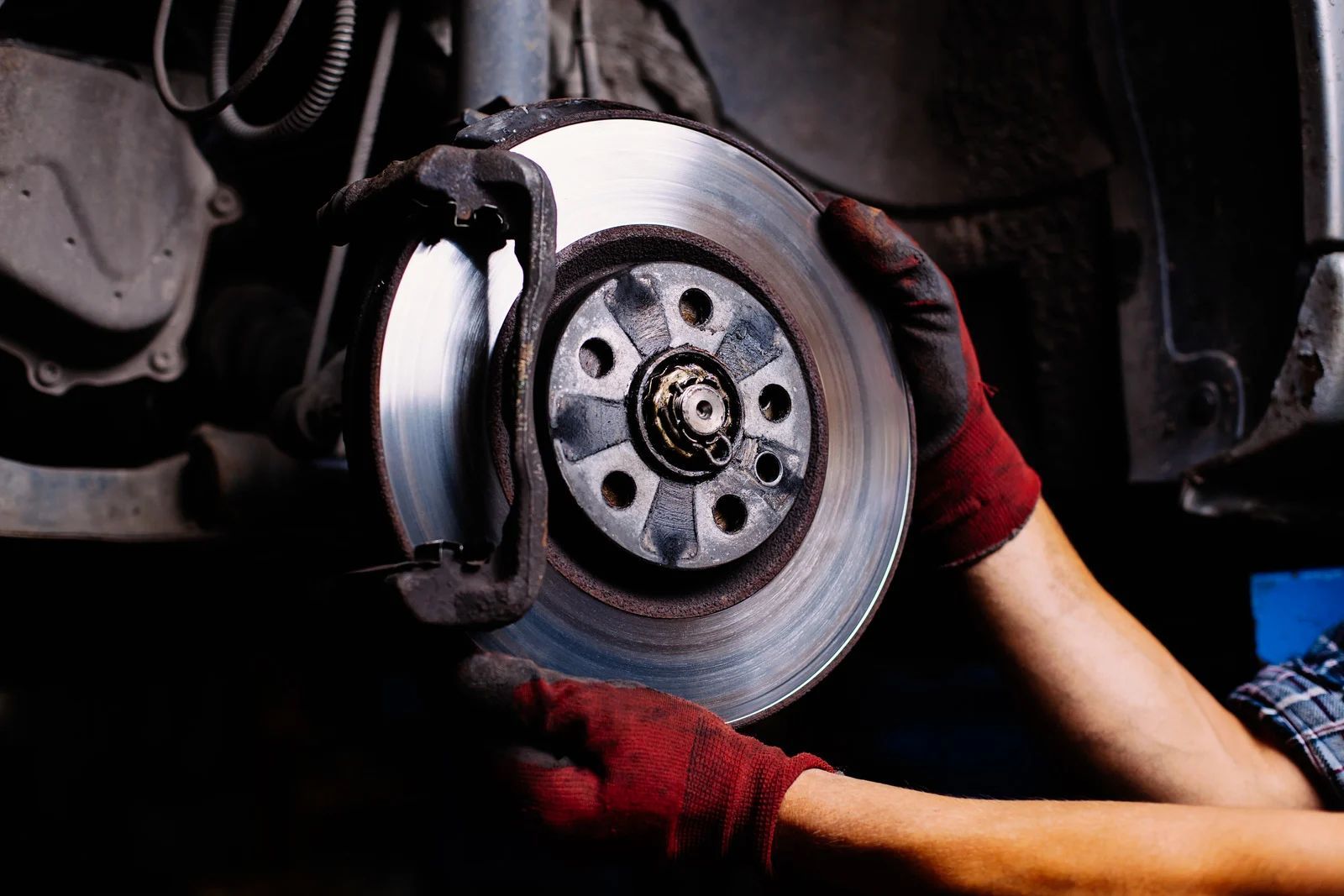
A brake pad is a block of friction material, usually a few inches long, bonded or riveted to a steel backing plate. It sits inside the caliper, the clamping unit mounted over the rotor at each wheel. Press the pedal, and hydraulic pressure pushes the caliper's pistons, which squeeze the pads against the spinning rotor from both sides. That friction between pad and rotor is what actually slows the wheel.
Pads generally come in one of a few flavors: ceramic compounds, semi-metallic blends with steel or iron fibers mixed into a resin, or organic compounds built around fiberglass. Each behaves a little differently under heat and produces different amounts of brake dust. But all of them exist to do the same job — convert motion into heat and slowly wear away while doing it. That's not a design flaw. Pads are the sacrificial part on purpose. Replaceable friction material is a lot cheaper and easier to deal with than letting bare metal grind on metal.
What a Rotor Actually Does
The rotor is the flat metal disc bolted to the wheel hub, spinning right along with the wheel. Most passenger vehicles run rotors machined from cast iron, and many include an internal vented structure between the two braking surfaces to pull heat away faster than a solid disc could manage on its own.
If the pad's job is generating friction, the rotor's job is giving that friction a stable surface to happen against and then getting rid of the heat it creates. A moving vehicle carries real kinetic energy, and braking doesn't erase that energy so much as convert it. Friction at the pad-rotor interface turns motion into heat, and that heat has to go somewhere. Rotors are built solid, out of metal rather than friction material, specifically to absorb that heat and shed it before it damages anything nearby.
Two Parts, Two Different Wear Patterns
Pads and rotors are made from different materials for different jobs, so naturally they wear out differently too.
Pad wear tends to be linear. Every clamp of the caliper transfers a microscopic layer of friction material onto the rotor and into the air as dust. It happens the same way, stop after stop, so pad thickness declines in a fairly predictable line from new down to the metal backing plate.
Rotor wear is messier. A rotor can lose material evenly the same way a pad does, but it's also exposed to failure modes pads never see. Uneven heating across the disc, often from a caliper that isn't releasing fully or from a string of hard stops from higher speed, can warp the metal slightly out of true. Grit trapped between the pad and rotor carves grooves into the surface over time. And a rotor that's already been resurfaced once, shaving off a thin layer to restore flatness, eventually runs too thin to resurface again and has to be replaced outright.
Why High Desert Driving Wears Both Faster
Local conditions load extra demand onto both parts — just in different ways.
Long, continuous mountain descents are hard on rotors specifically. Coming down the grade toward the mountain communities, brakes work for miles at a stretch instead of the short bursts typical of flat, in-town driving. That kind of continuous heat load is exactly what pushes rotors toward warping, because the surface never gets a chance to fully cool between applications. Riding the brakes the whole way down, instead of using a lower gear to help control speed, only piles on more heat than a quick stop at an intersection ever would.
Heat and dust hit pads in a different way. Summer pavement runs a good deal hotter than the surrounding air, which means brake components start every stop already carrying more heat than they would somewhere milder. That shrinks the margin before a pad's friction material starts breaking down chemically instead of just wearing mechanically the way it's supposed to. Fine dust and grit work their way into caliper slides and between the pad and its backing plate, and that can make a pad drag slightly or wear unevenly across its face instead of the flat, even pattern it was built for.
TIP: A pulsing brake pedal on a long downhill stretch, even one that fades once you're back on flat ground, is worth mentioning at your next inspection. Rotor warping from sustained heat tends to start subtle and get more pronounced with each descent, so catching it early usually means a simple resurfacing job instead of a full rotor replacement down the road.
When One Damages the Other
Pads and rotors don't wear in isolation. Ignore a squealing pad long enough and the friction material wears through completely. Once that happens, the exposed metal backing plate starts grinding directly against the rotor face, and that contact carves grooves into the rotor almost right away. What should've been a simple pad swap turns into a pad-and-rotor job.
It works the other direction too. A rotor with a warped surface or deep grooves doesn't sit flat against a new pad. Instead of even contact across the whole pad face, the pad only touches the high spots. Those spots wear down faster, the rest of the pad stays thicker, and the pedal can develop the same pulsing feel everyone blames on the rotor alone.
That's why a real brake inspection checks both parts together instead of eyeballing the pad and calling it done. A pad that looks fine at a glance can still be riding against a rotor surface that's already compromised. Swap the pad without addressing the rotor, and you've just set up round two of the same problem.
WARNING: A grinding, metal-on-metal sound, a pedal that pulses hard enough to feel through the steering wheel, or a car that pulls to one side under braking are not wait-and-see symptoms. Any of these can mean a pad has worn through completely or a rotor has degraded enough to cut into stopping power. Get the vehicle inspected before driving it any real distance, especially before a mountain descent where sustained braking asks the most of a system that's already struggling.
Reading the Signs: Pad Problem or Rotor Problem
A few clues point toward one part or the other before a technician ever pulls a wheel.
A high-pitched squeal that shows up consistently, especially right when you start driving, usually points to the built-in wear indicator doing exactly what it's designed to do. A grinding or growling sound instead is more serious, and it often means the pad has already worn through. Rhythmic pulsing or vibration felt through the brake pedal, sometimes through the steering wheel too, tends to point toward a warped rotor rather than a worn pad. Visible scoring, or a small lip built up around the rotor's outer edge, felt as a ridge when you run a finger along the unworn portion, is another rotor-specific sign.
Longer stopping distances and a car pulling to one side can come from either part, honestly — or from something unrelated, like uneven tire pressure or a caliper that's sticking. That overlap is exactly why guessing from symptoms alone only gets you so far. A sound or a feeling can point you in a direction. Only a real inspection tells you what's actually happening at the wheel.
Frequently Asked Questions
Do brake pads and rotors need to be replaced at the same time?
Not always. Pads wear out faster by design and get replaced more often than rotors. A healthy rotor can often be reused with fresh pads if it measures within spec and shows no deep grooves.
Can a rotor be resurfaced instead of replaced?
Often, yes. Resurfacing removes a thin layer of metal to restore a flat surface, which works when grooving or warping is minor and enough material remains. Once it's too thin, replacement becomes the only option.
How long do brake pads typically last?
Somewhere between 25,000 and 60,000 miles for most vehicles, though driving habits shift that number quite a bit. Stop-and-go traffic, frequent mountain driving, and heavy loads all shorten it, while gentle highway driving stretches it.
Why do my brakes squeal even though the pads still look thick?
That squeal usually comes from the wear indicator tab contacting the rotor on purpose, an early warning rather than a final one. It doesn't mean the pad is done, but an inspection is worth scheduling.
Does hard braking wear out rotors faster than pads?
Aggressive braking generates more heat than gentle stops, and rotors bear most of it since shedding heat is their job. Hard stops or downhill grades are more likely to warp a rotor than wear pads.
Is a warped rotor dangerous to drive on?
It reduces braking consistency and can stretch stopping distances, but the bigger issue is what it does downstream, uneven pad wear and a pulsing pedal. Worth fixing before it worsens, especially before long mountain drives.
Two Parts Working Together, Telling Different Stories
Pads and rotors sit only inches apart inside the same wheel, yet they wear on separate timelines and fail for separate reasons. A pad worn thin still shows itself early, through that built-in squeal most drivers learn to recognize. A rotor problem waits longer to surface, often announcing itself only once a pulse works its way into the pedal or steering wheel. Neither part exists in isolation, and letting one slide past its useful life almost always shortens the other's lifespan too.
Bear Valley Auto Center
has spent 50
years working on
brake systems
throughout Hesperia, CA, watching that same pad-and-rotor relationship play out across thousands of vehicles built for very different roads and driving habits. That kind of repetition is what makes the difference between a pad swap that solves the problem and one that only delays a second visit. Knowing what each part does, and how they wear against each other, makes it easier to catch a small issue before it turns into a bigger one.